
Understanding Rice County Released Inmates
A release means one authority ended its control over a person. It does not always mean the person went home. Someone may leave the Rice County Detention Center on bond, after dismissal, by court order, after serving the required time, or on probation. The person may instead transfer to another county, the Kansas Department of Corrections, the U.S. Marshals Service, or Immigration and Customs Enforcement. Each event removes the person from Rice County jail control, but only some are community releases.
The agency that owns the event is the best source. The Sheriff holds the physical booking and custody-end record. The Rice County District Court holds the order or case entry that may explain the legal cause. KDOC records a prison release, parole, mandatory postrelease supervision, or final discharge. Federal agencies keep their own records. “Discharge” usually means an obligation has ended, while “release” can occur even though a case, sentence, or supervision term remains open.
- Time served
- Release after required jail time or credited custody time has been met.
- Parole
- Release from prison under state supervision before final discharge.
- Probation
- A court-ordered community sentence that may follow or replace jail time.
- Detainer
- A request by another authority to hold or receive a person.
Rice County Release Paths
The recorded release reason controls the next search. A bond event can end the jail stay while the criminal case continues. A transfer closes the local custody episode but begins custody elsewhere. State prison release can lead to parole or mandatory postrelease supervision, which is a required supervision term after prison for many determinate sentences. Final KDOC discharge is different because KDOC and the Prisoner Review Board no longer retain supervisory authority.
| Release path | What it means | Best next record |
|---|---|---|
| Bond or recognizance | County jail control ends after the court permits release and holds clear. | Sheriff release record and court bond order |
| Dismissal or time served | The cited case may end, though another hold may remain. | Jail record plus court disposition |
| Probation | The person is outside jail under a court sentence. | Rice County court docket |
| KDOC transfer | Local custody ends, but state custody begins. | KASPER offender search |
| Federal or ICE transfer | Another authority receives the person. | Federal docket, BOP, or ICE locator |
| Parole or postrelease | Prison confinement ends while supervision continues. | KASPER and KDOC Parole Services |
Note: A release from one case does not clear a separate warrant, sentence, or detainer.
Rice County Release Record Fields
Rice County does not publish a universal release form online. A well-scoped request should identify one custody episode and ask for existing fields. These facts tie the custody end to the right person, case, and receiving authority. Exact labels can vary in the Sheriff’s system, so a request should ask for the recorded term rather than presume which term staff used.
| Field | What it shows |
|---|---|
| Full identifying name | The person associated with the booking |
| Booking number | The specific jail episode |
| Admission date and time | When county custody began |
| Booking agency and case | The arresting source and court tie |
| Charge or hold | Why custody was recorded |
| Release date and time | When Rice County control ended |
| Release type or reason | Bond, order, time served, transfer, or another recorded basis |
| Destination or receiver | Another agency, if staff recorded it |
The court record is not a substitute for the exact physical time. A judge can issue an order before jail staff finish checks and processing. Likewise, a VINE alert reports a custody change but does not prove the destination. When precision matters, compare the Sheriff record with the docket and any receiving agency’s record.
Request Rice County Release Records
Direct the request to the Rice County Sheriff’s Admin/Records custodian at 1442 West Commercial Avenue, Lyons, Kansas 67554, or call 620-257-7876 option 2. Administrative hours are Monday through Friday, 8:00 a.m. to 4:00 p.m. The county information-request route can serve as an initial written channel. State that the request is made under the Kansas Open Records Act and seeks Sheriff or Detention records.
- Give the full name, birth date if known, and approximate booking date.
- Ask for the booking sheet, booking number, admission and release times, recorded release reason, destination if recorded, bond record, and photograph.
- Request electronic copies, accept lawful redaction, and ask for all segregable public portions.
- Ask for a fee estimate and the statute supporting any withheld field.
- Keep the jail record distinct from any KDOC, court, BOP, or ICE request.
The Sheriff publishes a $5 cash report fee and asks for the exact amount, but does not say it applies to every jail release record or photograph. Ask whether that fee applies and whether staff or copy charges will be added. No dedicated release-record form was found. Under K.S.A. 45-218, the custodian must act as soon as possible and by the end of the third business day. That is a response deadline, not a promise of full production.
Rice County Expunged Release Records
Kansas conviction-expungement timing under K.S.A. 21-6614 runs from sentence satisfaction or discharge from probation, community corrections, parole, postrelease supervision, conditional release, or a suspended sentence. Many eligible lower-level matters use a three-year baseline, while listed offenses use five years and some are not eligible. The exact offense and statute control.
An expunged court record may disappear from public access. That does not prove every independent copy vanished. Registration rules are also separate. Under K.S.A. 22-4909, a registration conviction may remain subject to registration even when public display changes after expungement. Juvenile, sealed, expunged, and protected investigative material may be withheld, but requesters can ask for nonexempt portions and the legal basis for each denial.
Rice County Release Record Laws
Kansas law treats a release event as its own custody fact. K.S.A. 45-217 defines criminal-investigation records in a way that expressly excludes jail and detention-facility inmate rosters. That rule prevents an agency from treating the full roster as confidential merely because it concerns arrests. It does not make every booking-file field public. Each requested field still receives its own review under the Kansas Open Records Act, and a valid exemption can support redaction or withholding.
K.S.A. 22-4701 also says criminal-history record information does not include release, work release, or another custody-status change for a person confined by KDOC or a jail. At the same time, K.S.A. 22-4705 identifies release from detention or confinement as an event reported to the central repository. Read together, these provisions show why a custody-end record is not the same product as a broad criminal history. A request for one Rice County booking and release episode should stay focused on the existing custody facts.
K.S.A. 45-221(a)(29) generally permits an agency to withhold identifiable correctional records, but it names important information that remains subject to disclosure. The listed areas include name, photograph and identifying data, sentence information, parole-eligibility date, custody or supervision level, disciplinary record, supervision violations, non-treatment conditions, facility, and parole-office location. If the Sheriff or KDOC denies a broad request, ask which precise provision applies and whether redaction permits partial release.
Retention is a separate issue. Rice County publishes no online archive or retention period for jail booking, release, or photograph records. A record’s absence from the public web does not establish destruction. Ask the records custodian which approved schedule applies to the requested file. That answer is more sound than assuming a 24-hour or 72-hour publication window that the county does not offer.
Note: Public access can narrow for juvenile, sealed, expunged, or protected investigative material, even when basic custody facts are sought.
Bonding Out in Rice County
The official Rice County Inmate Information page publishes approved bonding companies for the 20th Judicial District. That confirms bond as a local release path, but the page gives no county bond schedule and promises no instant release. Court approval, jail processing, and other holds can affect the outcome.
Confirm the bond order in the Rice County court record. Then call Detention at 620-257-7877 option 1 for the physical custody status. A bond-company payment alone does not establish when the person left, and an active detainer can prevent a return to the community.
Find Rice County Released Inmates
Start by asking which authority last held the person. Rice County has no public web roster or recent-release feed, so absence from a page proves nothing. For a recent local booking, Detention is the first source. When staff cannot disclose the fields by phone, Admin/Records is the fallback. The case docket then explains the court event without being treated as proof of the exact exit time.
- Call Rice County Detention with the full name and approximate booking date. Ask whether that episode ended and whether another agency received the person.
- Search the Kansas court portal by name or case number, narrowed to Rice County criminal matters.
- If state prison or supervision appears, search KASPER by name, KDOC number, or other supported fields.
- Use Kansas VINE for a person still shown in county custody and register for a later event notice.
- For federal or immigration custody, use the federal docket, BOP locator, or ICE ODLS as the facts require.
- If no channel resolves the event, request the existing Sheriff release record.
Rice County Release Court Records
Rice County belongs to the 20th Judicial District. The statewide eCourt portal is the main online docket route. Search by a name or case number, narrow the result to Rice County and criminal matters, then review the register of actions and available documents for a bond order, dismissal, sentence, jail credit, probation, revocation, amendment, satisfaction, or expungement proceeding.
The docket often survives after public jail data is no longer visible, but it proves a legal event rather than the precise physical release hour. Open files can also be inspected at the Rice County District Court, 101 West Commercial Street, third floor, Lyons. Published office hours are Monday through Friday, 8:00 a.m. to 5:00 p.m.; the phone is 620-257-2383.
The Kansas district-court search guide shows how court records are reached.
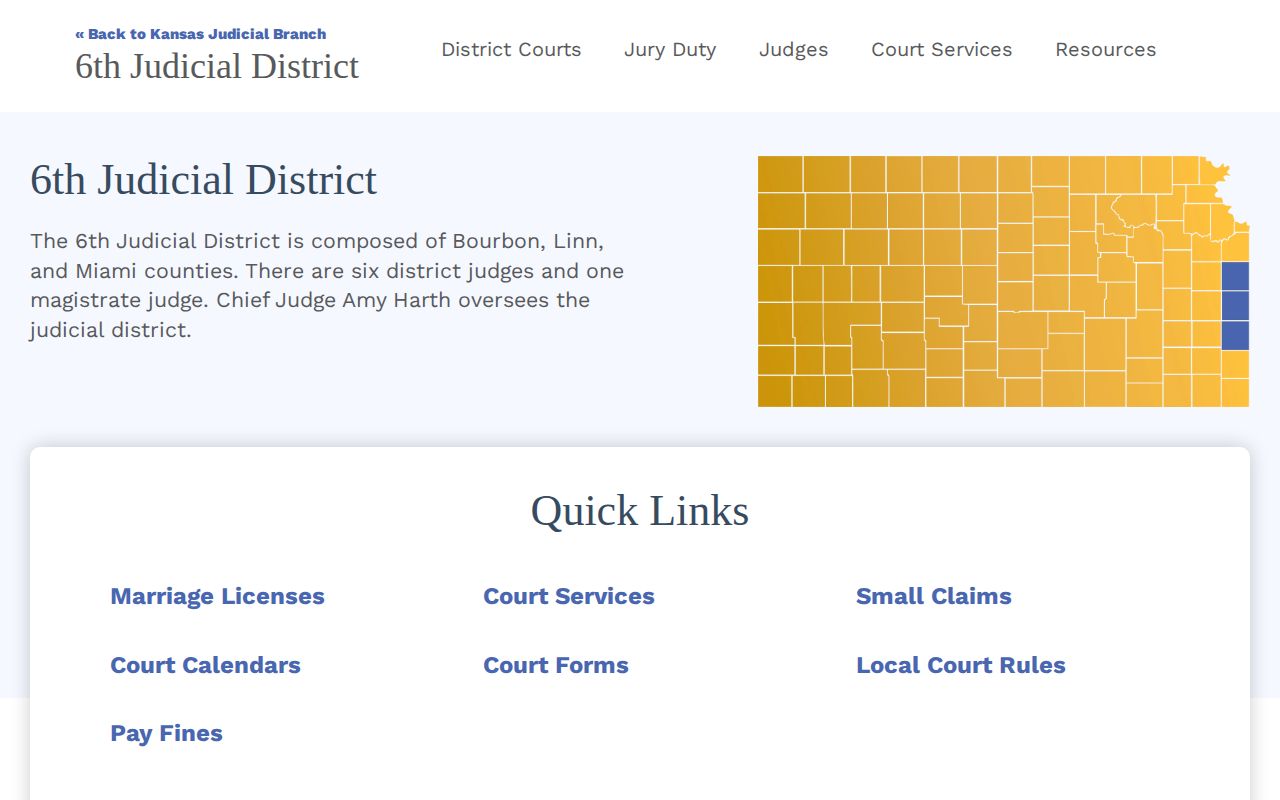
The guide supports using the docket to explain the order while leaving custody-end confirmation to the Sheriff.
Rice County KASPER Release Lookup
KASPER, the Kansas Adult Supervised Population Electronic Repository, covers state correctional and supervision records. It is not the default source for a county-only bond release. Search it when the court or jail indicates a KDOC transfer, state sentence, parole, or discharge. Its disclaimer also says the offense history is not a complete criminal history and warns that some community-corrections probation events after April 21, 2021 cannot be displayed.
| Search field | Use |
|---|---|
| Name and aliases | Broad identity search |
| KDOC number | Best exact state-system match |
| Birth date or age range | Separates similar names |
| State ID or KBI number | Additional identifier |
| Conviction county | Choose Rice when applicable |
| Supervision county | Find a Rice parole assignment |
| Supervision type | Includes Inmate, Parole, Discharged, and other statuses |
The official KASPER search requires acceptance of its terms before the form appears.
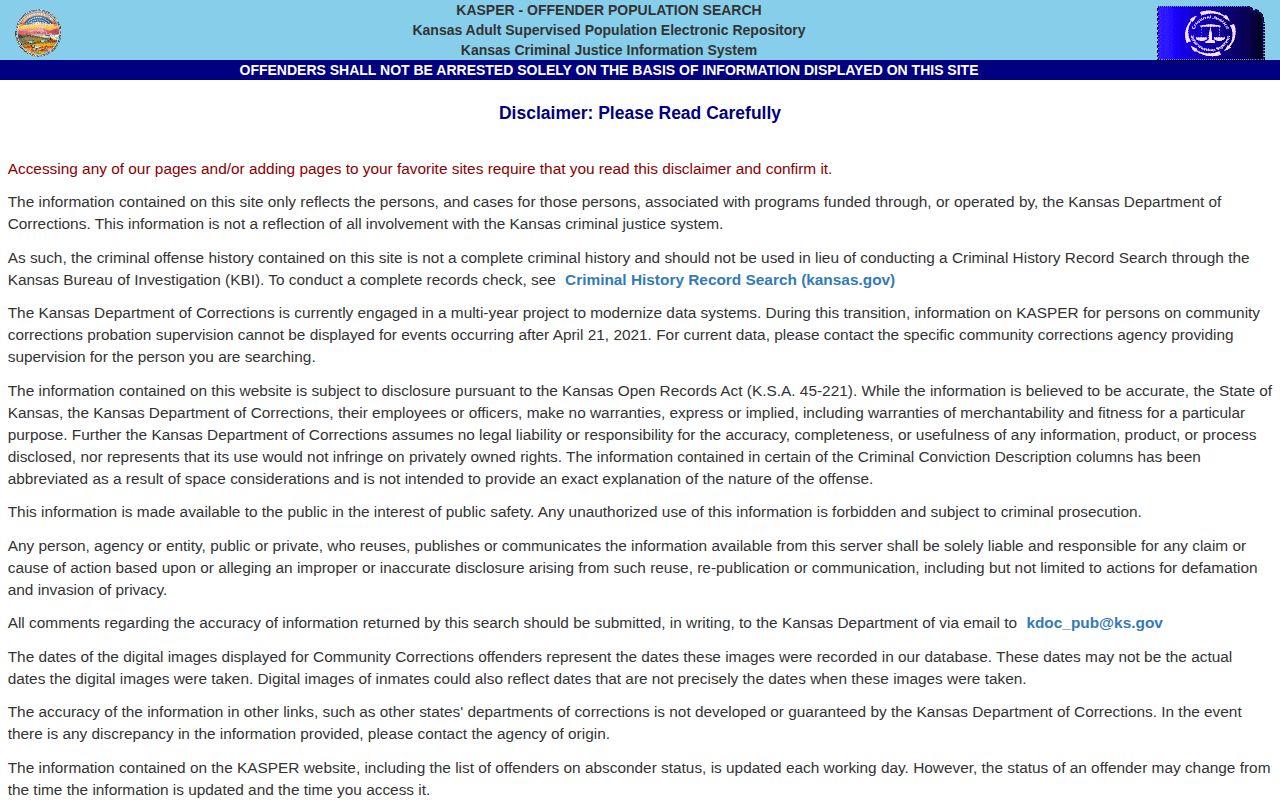
A Parole status means the person left prison but remains supervised. Discharged is a stronger lead that state custody and supervision ended, though KDOC records should confirm the date when needed.
Note: A KASPER no-result may mean the person never entered KDOC, not that no county release occurred.
Rice County Release Alerts
Kansas VINE covers adults in participating county jails and can provide notice of release, transfer, or escape. Registration should occur while the person still appears in county custody. An alert is a cue to call the jail because VINE does not establish the release reason or destination. Kansas VINE expressly excludes people held in KDOC state prisons, so a transfer to state custody requires a switch to KASPER and KDOC sources.
For post-release supervision, KASPER is a public starting point. Rice County parole cases are assigned to the Salina Parole Office, North Region. Ordinary court probation should be checked through the Rice County docket and the assigned court or community-corrections office because KASPER has a known probation-data limit. The full distinction is covered on the Rice County parole and probation page.
Rice County ICE Release Transfers
A Rice County jail “release” can lead to ICE custody. ICE states that a detainer may ask the jail to keep a person for up to 48 hours beyond the time local release would otherwise occur so the Department of Homeland Security can assume custody. That makes the county custody-end time, the detainer period, and the later ICE outcome three separate facts.
ICE ODLS searches by a nine-digit A-number plus country of birth, or by exact name, country of birth, and birth date. It covers current detainees and people released from ICE custody within the prior 60 days. A Rice County record followed by an ODLS detention result is consistent with a transfer. It is not conflicting proof. After the locator window closes, the relevant ICE Enforcement and Removal Operations office is the fallback.
Rice County Federal Release Checks
The BOP Inmate Locator applies to federal sentenced custody, not an ordinary Rice County case. A location of “RELEASED” and a past release date show that BOP custody ended. A future date is projected, “IN TRANSIT” does not mean released, and “UNKNOWN” means the confinement term has not been set. BOP online coverage chiefly reaches people released after 1982.
The BOP Inmate Locator supports register-number and name searches.
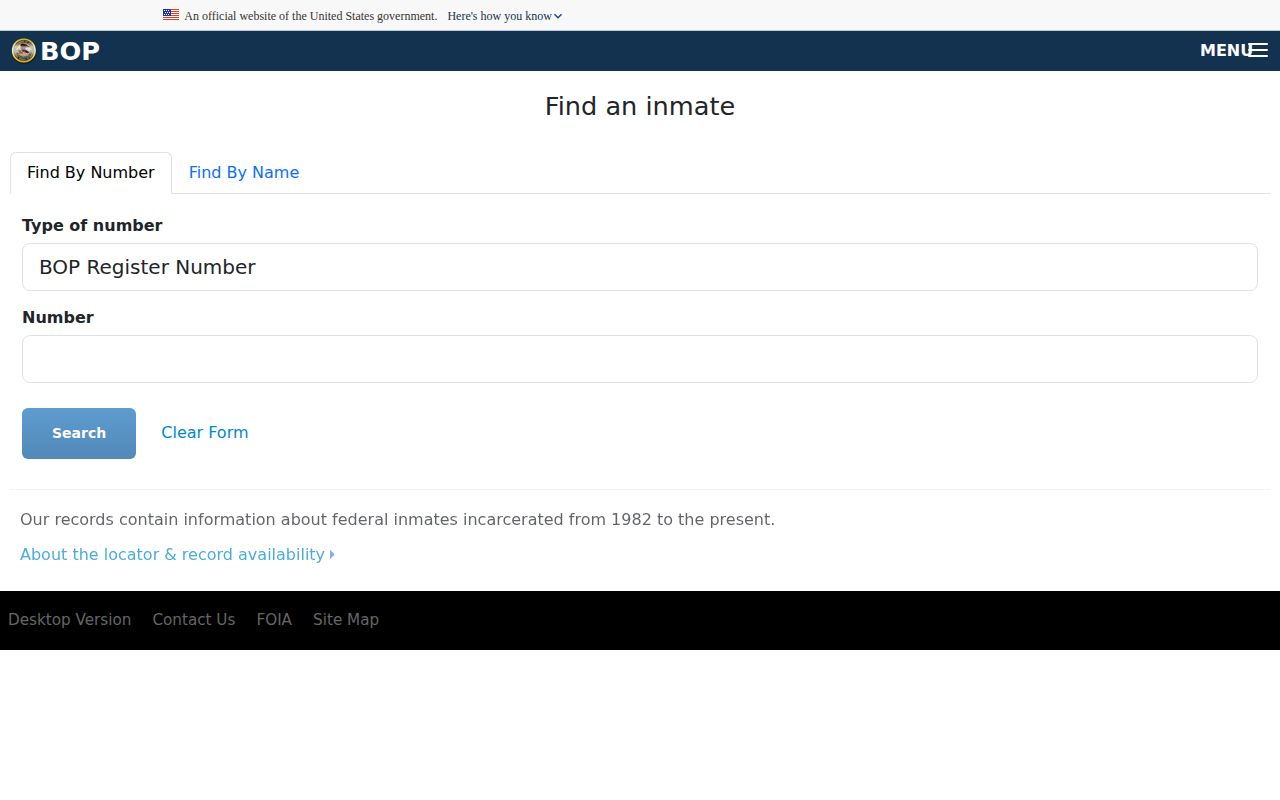
A BOP release does not show whether court-ordered federal supervision ended. For a USMS pretrial detainee, the federal court docket may be more useful because USMS has no comparable public historical locator.
Rice County Release Source Comparison
Use the source that owns the disputed fact. This avoids treating a no-result as a release and keeps a transfer distinct from a return to the community.
| Situation | Best source | What it can establish |
|---|---|---|
| Still in county jail | Detention and Kansas VINE | Current county custody and event alerts |
| Released from county jail | Sheriff record and court docket | Physical custody end and legal order |
| State prison or supervision | KASPER and KDOC | Inmate, parole, or discharged status |
| Federal sentenced case | BOP locator | Federal custody and release date |
| ICE custody | ODLS | Current detention or recent ICE release |
Can one missing result prove release? No. A spelling mismatch, sealed case, coverage limit, transfer, or old record can all cause a no-result. Move to the next source that fits the known custody path.
Rice County Release Facilities
Three systems matter to local release research. The Rice County Detention Center is the sole local jail identified in official county sources. It sends people to the community or another authority. KDOC institutions hold state-sentenced people and record parole, postrelease, and discharge in KASPER. BOP institutions hold federal sentenced prisoners and use the federal locator.
- Rice County Detention Center: confirm local release through Detention, Admin/Records, and the court.
- Kansas Department of Corrections: use KASPER for state custody and discharge.
- Federal Bureau of Prisons: use BOP only for federal sentenced custody.
No separate municipal, regional, state-prison, BOP, or permanent ICE detention site was identified inside Rice County. A Rice County defendant can still be held in those outside systems.
Public Record Search
Sponsored Results