
Rice County Projected Versus Actual Release
A projected date is a calculation made before release. It estimates when the confinement part of a sentence may end under the law and records then in force. An actual release date records what happened after the agency completed processing. The two can differ. Credit can be earned or lost, a court can amend a sentence, another agency can lodge a hold, or a calculation can be corrected. Even a near-term date should be treated as scheduled until Rice County Detention or KDOC confirms that physical release occurred.
Pretrial custody works in a different way. A person held while a Rice County case is pending does not have a sentence-based release date. Bond, dismissal, a plea, trial, a remand order, or another hold can change the outcome. Remand means a court has ordered the person back into custody. The Rice County court docket may show the legal event, while Detention confirms whether county custody ended. A transfer from the jail to KDOC, federal custody, or another county is a county custody end, but not a release to the community.
Find Rice County Projected Release Dates
The first task is to identify the authority. KASPER covers Kansas Department of Corrections prisoners and relevant state supervision records. It does not cover every person booked into the Rice County Detention Center. The county does not publish a live jail roster or a public recent-release feed, so a county calculation requires direct contact and the court record. Federal sentences use the Bureau of Prisons locator and its own rules.
- Check the Rice County case for a bond order, sentence, amended journal entry, jail credit, or transfer to state custody.
- For a county detainee, call Rice County Detention at 620-257-7877, option 1. Ask whether a release date is recorded and whether another hold exists.
- For a Kansas state prisoner, open the KASPER search, accept its disclaimer, and use the KDOC number when known.
- Search by name and aliases when no KDOC number is available. Use Rice as conviction county only for a state sentence originating there.
- Open the matching detail and preserve the exact date label, value, and access date. Do not rename a displayed field.
- Confirm an unclear or near-term calculation with KDOC. For county time, request the jail’s actual computation and compare it with the court order.
KASPER’s public form also allows photo choices, demographic fields, conviction county, parole supervision county, community-corrections location, and supervision type. Those filters help separate people with similar names. Inmate describes current state confinement. Parole means release from prison to supervision. Discharged is stronger evidence that the state obligation ended. A current-custody roster should never be used as the sole way to confirm a past release.
The exact public KASPER label for a future release calculation was not verified in the research because a stable current-inmate detail could not be opened through the protected form. No field name is invented here. The Rice County release search and record process supplies the fallback when a person’s custody path is not yet known.
Rice County Good-Time Calculations
Kansas calculations begin with the sentencing system, offense date, sentence terms, and any jail credit. The Kansas Prisoner Review Board explains two broad systems. An indeterminate sentence has a minimum and maximum and may require a parole-suitability decision. A determinate guidelines sentence has a fixed prison portion followed by mandatory postrelease supervision. The Board does not choose the first statutory release for a determinate case in the same way it decides parole suitability for an indeterminate case.
K.S.A. 21-6821 authorizes rules for earning and forfeiting good time based on conduct, work, programs, and related factors. For crimes committed on or after July 1, 1993, the amount subtracted from the prison part is generally capped at 15 percent. That can produce the common “serve 85 percent” shorthand only when the case falls in that class and all available credit is earned and kept.
The official Kansas good-time and program-credit statute is shown below.
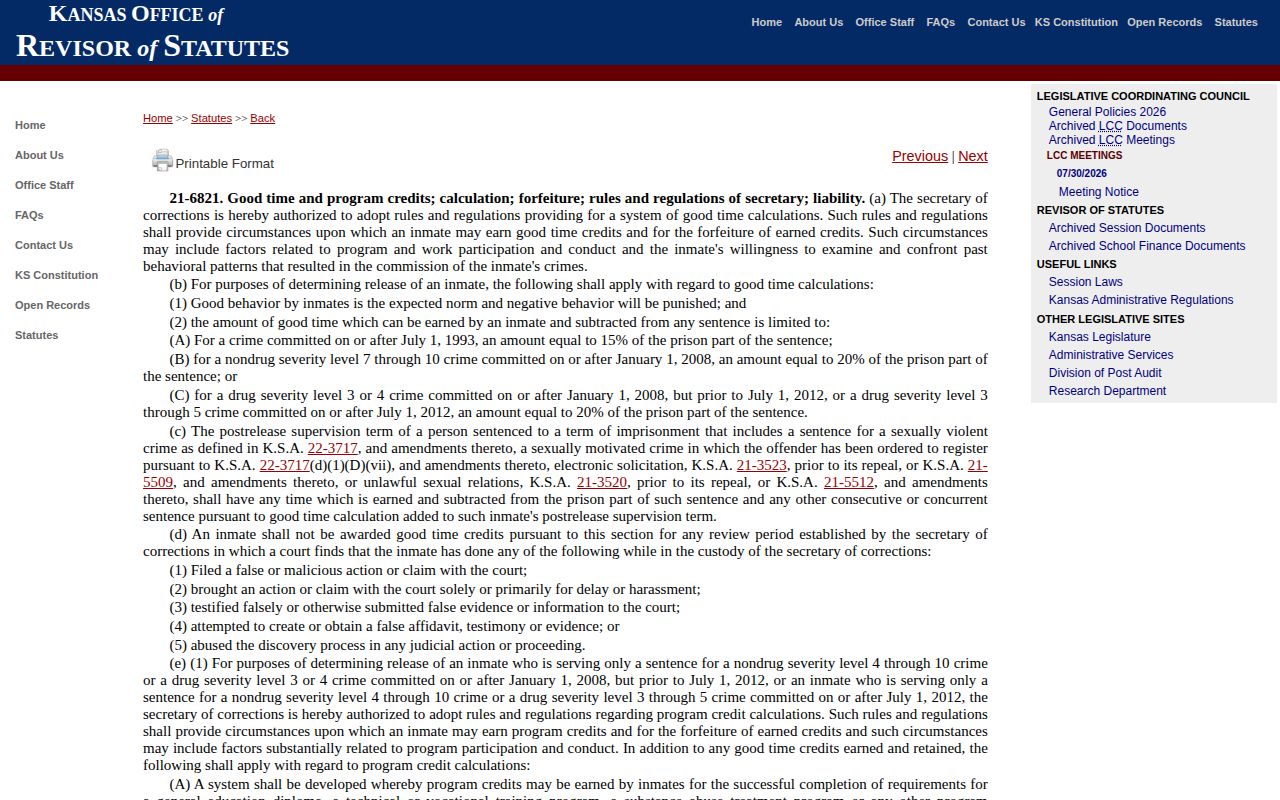
The statute’s offense-date and severity distinctions explain why a single percentage cannot reliably predict every Rice County state-prison release.
Why Rice County Release Dates Change
A projection is built from several moving parts. Consecutive sentences run one after another, while concurrent sentences run at the same time. An amended journal entry can alter the legal sentence. Jail credit can change the time left to serve. Good time and program credit depend on statutory eligibility and retained credit. A detainer is a request or notice from another authority that may prevent a person from walking free when one custody term ends.
| Factor | Possible effect | Best confirmation |
|---|---|---|
| Amended court order | Changes the sentence, credit, or controlling dates | Filed journal entry and agency computation |
| Good-time forfeiture | Moves a projected prison exit later | KDOC sentence record |
| Program credit | May reduce confinement for an eligible sentence | KDOC calculation under the statute |
| Concurrent or consecutive terms | Changes how multiple sentences combine | Court orders and KDOC computation |
| Detainer or hold | May lead to transfer instead of community release | Holding agency and Detention or KDOC |
| Parole decision | Affects eligible indeterminate cases | Prisoner Review Board and KASPER |
| Computation correction | Adjusts an earlier projected value | KDOC or jail records |
Special rules also apply to some off-grid and serious offenses. K.S.A. 22-3717 contains offense-specific minimums and limits that should be read in the current statute. Those cases cannot be reduced to a broad percentage. A date may also mark release from prison to supervision, not final discharge from all KDOC authority.
Confirm Rice County Actual Release
County and state channels have firm boundaries. Kansas VINE covers adults held in participating county jails and can send notice of release, transfer, or escape. It expressly excludes KDOC offenders housed in state prisons. A person followed in VINE while at the Rice County Detention Center must be researched through KASPER after a transfer to state prison. VINE is a notice tool, not the underlying sentence calculation or proof of sentence completion.
For a county case, call Detention for present status and use Admin/Records for a reproducible booking or release record. The court docket can confirm the order that led to bond, probation, dismissal, sentence, or transfer. If oral access is limited, request the existing record rather than asking staff to create an explanation. Include the full name, approximate booking date, and the date or type of custody event sought.
For a state case, record the KASPER result and then ask KDOC to confirm a close date or ambiguous label. A person shown as Parole has left prison but remains under supervision. Discharged indicates a later and broader end point. For county-jail alerts and their limits, the Rice County VINELink check explains the specific-person notification path.
Note: A VINE notice or online date can lag, so direct agency confirmation remains essential for time-sensitive plans.
Does Rice County Serve 85 Percent?
The short answer is not always. Kansas’s 85 percent phrase describes the usual result of a 15 percent good-time cap only for a sentence within that rule and only when all credit is earned and retained. It is not a universal truth-in-sentencing formula. The offense date, grid severity, sentence structure, conduct, and special statutes can all produce a different calculation.
For certain nondrug severity levels 7 through 10 committed on or after January 1, 2008, and for specified drug offenses, the good-time cap is 20 percent. That can yield 80 percent confinement when the person earns and keeps the full credit. Eligible people serving only specified severity-level sentences may also earn up to 120 days of program credit by completing designated education, training, treatment, or other risk-reducing work. The credit does not apply to all convictions, and completion of sex-offender treatment does not earn that program credit.
Some credit removed from prison can be added to postrelease supervision. Kansas explains this as a common feature of determinate terms, and the statute has specific treatment for certain sexual and related offenses. A sooner prison exit can therefore mean more time under community supervision rather than a shorter total state obligation. This is why the projected prison-release date and the maximum discharge date must remain separate.
Rice County Parole Eligibility Dates
K.S.A. 22-3717 governs parole eligibility, conditional release, and postrelease. For many pre-guidelines indeterminate cases, the basic calculation starts with the minimum term less good time, though the statute contains many exceptions. KDOC explains that a minimum of two or more years can earn one day of good time for each day served, which may produce eligibility at one-half of the minimum if all credit remains. A one-year minimum may reach eligibility after nine months. Conditional release is generally tied to one-half of the maximum if credit is not lost.
Eligibility is not release. The Prisoner Review Board considers suitability for applicable indeterminate cases and may parole, continue the matter for more information or deliberation, or pass the case for a stated period. The Board’s public schedule and listed-resident pages show future process rather than actual outcomes. A person on an upcoming list should not be reported as scheduled for release.
The official Prisoner Review Board process page provides the state explanation shown below.

The process makes clear why hearing eligibility, a favorable decision, physical release, and final discharge are four different events.
Rice County Jail Sentence Computation
KDOC percentages should not be applied automatically to a Rice County jail sentence. The court’s sentence, the journal entry, jail-credit orders, and the jail’s own calculation control the local term. No Rice County jail good-time or weekend-release policy was found in the reviewed official material. It would be inaccurate to promise a standard early-release percentage or a routine move to the prior weekday.
Ask Rice County Detention for the actual computation. If proof is needed, request the existing record from Sheriff Admin/Records and compare it with the District Court file. The Sheriff administrative office and records number is 620-257-7876, option 2, with published hours Monday through Friday from 8:00 a.m. to 4:00 p.m. The office is at 1442 West Commercial Avenue in Lyons. Its published $5 cash, exact-amount report fee is not stated as a separate release-calculation fee, so ask for a written estimate and confirm applicability.
A court record can explain a sentence, bond change, revocation, or amended credit. It may not prove the exact time staff completed physical release. Conversely, a jail record can document the custody event without resolving every legal issue in the case. Matching both records gives the strongest answer when a Rice County projected release date and the actual event differ.