
Rice County Parole Versus Probation
Several forms of supervision can follow Rice County custody, but they are not interchangeable. Parole applies mainly to an eligible person released from an indeterminate Kansas prison sentence by the Kansas Prisoner Review Board. A determinate guidelines sentence generally leads to mandatory postrelease supervision after the prison part ends. Probation is a court sentence served in the community instead of prison or jail, subject to court terms. A person released before the case ends may also be on supervised bond. That is a pretrial court status, not parole and not a final sentence.
The agency follows the legal source of supervision. KDOC and its parole offices manage parole and state postrelease cases. Rice County court probation and bond supervision can route through Twentieth Judicial District Court Services, whose central office serves five counties. KASPER is useful for the state side, but KDOC warns that community-corrections probation events after April 21, 2021 may not appear during system modernization. The Rice County docket and the assigned court or community-corrections office are therefore the better checks for current probation.
| Status | Who orders it | Where to verify |
|---|---|---|
| Parole | Kansas Prisoner Review Board for an eligible indeterminate case | KASPER, then the Salina Parole Office |
| Mandatory postrelease | Follows a determinate Kansas prison term under state law | KASPER and KDOC Parole Services |
| Probation | District court at sentencing | Rice County court record and assigned court or community-corrections office |
| Supervised bond | Court before final disposition | Court docket and Court Services |
- Parole
- Release from prison to supervision before maximum discharge in an eligible case.
- Probation
- A court-ordered sentence served in the community under stated terms.
- Postrelease supervision
- Supervision that follows the prison part of a determinate Kansas sentence.
- Discharge
- The end of the state correctional obligation, not merely release from confinement.
Verify Rice County Post-Release Supervision
Start with the sentence and custody path. A person who left the Rice County Detention Center may have bonded out, received probation, transferred to KDOC, or left after serving a county sentence. Only the state-custody path calls for KASPER parole or postrelease records. The official KASPER search allows a Rice conviction-county filter, a Rice parole-supervision-county filter, and supervision types that include Inmate, Parole, Community Corr., Absconder, Discharged, and All.
- Check the Rice County court disposition to learn whether the case produced probation, a state-prison sentence, or another outcome.
- For a KDOC case, accept the KASPER disclaimer and search by KDOC number when known. A name and aliases can also be used.
- Choose Rice as conviction county for a state sentence that began in Rice County. Use Rice as parole supervision county only when the person is supervised there.
- Read the status precisely. Parole means release from prison with supervision. Discharged is stronger evidence that KDOC authority ended.
- For probation or supervised bond, verify the docket and contact the assigned court, Court Services, or community-corrections office.
- Confirm an unclear or time-sensitive state result with the official parole office rather than inferring a status from absence.
The broader Rice County released-inmate search and release-record path helps distinguish a county release from a transfer into state or federal custody. Kansas VINE can send county-jail release or transfer notices, but Kansas expressly excludes KDOC prison offenders from that system. Once a Rice County detainee enters state prison, KASPER and KDOC become the correct channels.
Rice County Parole Office Route
Rice County state parole cases are assigned by the official KDOC table to the Salina Parole Office in the North Region. This sourced assignment matters. A closer-looking office should not be selected by guesswork. The office can explain routing and procedure, subject to confidentiality limits, when a KASPER entry is unclear or the named supervising location needs confirmation.
919 E. Prescott, Suite 300
Salina, KS 67401
785-827-2584
KDOC parole-office contacts
Probation follows a different route. Twentieth Judicial District Court Services has its central office at 1806 Twelfth Street, Great Bend, KS 67530, and can be reached at 620-793-1887. It serves Barton, Ellsworth, Rice, Russell, and Stafford Counties. Its officers supervise adult and juvenile probationers, supervise bond cases, prepare presentence work, and travel to outlying counties. A person reporting through that office should not be described as a KDOC parolee unless the state record independently supports parole.
Note: Office assignment can turn on the case and supervision type, so confirm current routing before an in-person visit.
Rice County Supervision Conditions
Conditions are the rules attached to community supervision. They can include reporting, travel limits, program participation, payment duties, or other case-specific terms. The public KASPER record does not replace the written order or instructions given by the supervising officer. A claimed violation may lead to review, a warrant, or revocation proceedings, but the outcome depends on official action and due process. Being outside prison while a violation is reviewed does not mean the person has discharged the sentence.
The Kansas Prisoner Review Board sets postrelease conditions for determinate cases and handles violations or revocations within its authority. It also has roles in parole, conditional release, and discharge. County probation violations remain court matters. Use the Rice County docket for filed orders and hearing events, while recognizing that a docket entry may explain the legal status without proving the exact place or hour of physical custody.
Rice County Absconder Checks
KASPER provides distinct Parole Absconders and Community Correction Absconders channels. An absconder is a person alleged to have stopped reporting or otherwise left supervision without authorization. The two lists reflect different supervision systems. A parole entry should not be recast as court probation, and a community-corrections entry should not be called parole.
The KASPER warning is direct: no one should try to arrest a person solely because of displayed information. Treat an entry as a lead for official verification. It is not proof of a new crime, a final court ruling, or permission for public intervention. Contact law enforcement only through ordinary official channels if there is an immediate safety concern. Otherwise, verify the status with the listed agency or supervising office.
The image below comes from the official KASPER Parole Absconders channel.
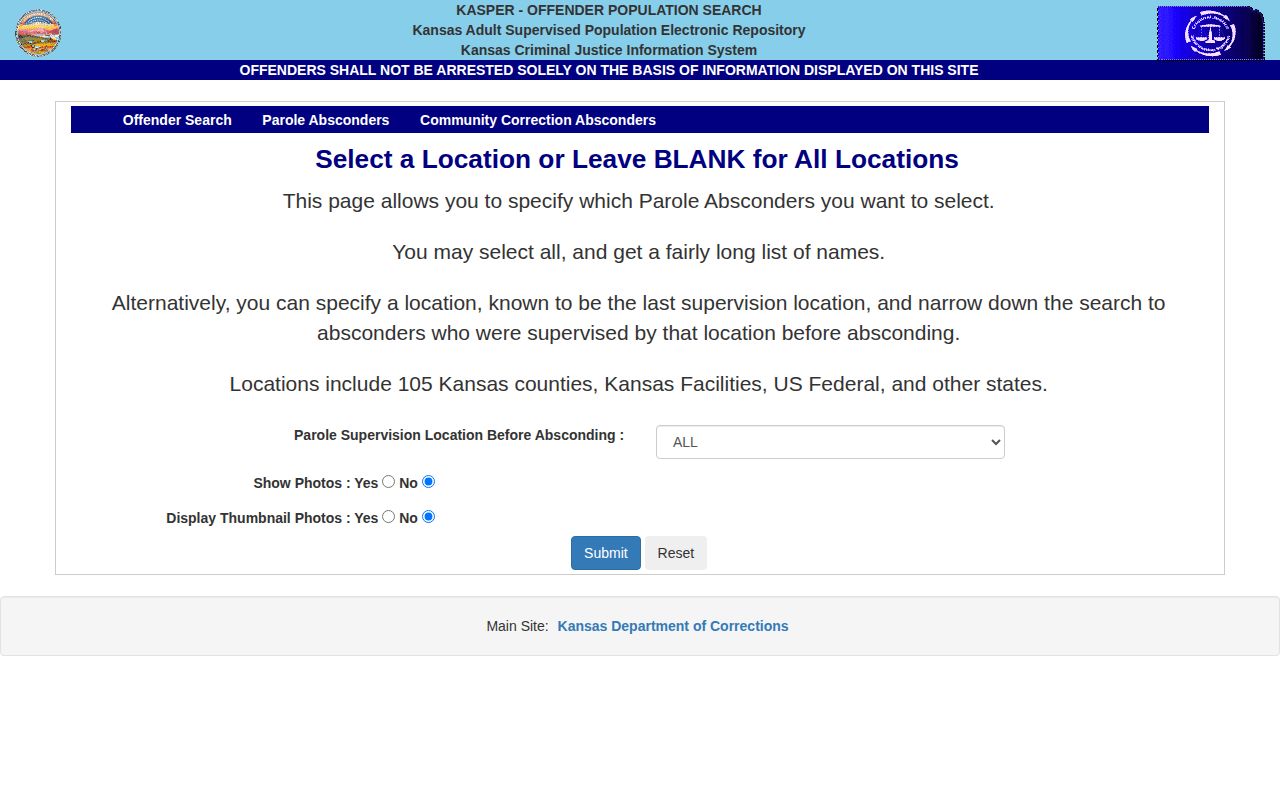
Its separate search route reinforces why Rice County parole and community-corrections claims must be checked against the correct state channel.
Rice County Parole Hearing Records
The Kansas Prisoner Review Board handles parole suitability for indeterminate sentences. For determinate guidelines sentences, it sets postrelease conditions and handles violations or revocations, but it does not choose the initial statutory prison release in the same way. This difference prevents a projected state release from being described as a parole grant when the sentence instead leads to mandatory postrelease supervision.
The Board’s public-comment hub publishes a schedule and a list of residents with upcoming hearings. Those pages are prospective. They show process ahead, not release results. KDOC states that an in-state parole hearing occurs during the month before eligibility. Eligibility means the person can be considered; it does not mean the Board found the person suitable for release.
Verified decision terms include parole for suitable release, continue for more deliberation or information, and pass for denial during a stated period. No official public database of individual results was found in the Rice County research. A later outcome should be checked through KASPER, KDOC contact, or a records request, not inferred from the upcoming-resident list.
Note: A hearing schedule is not a Rice County release list and does not establish that release occurred.
Rice County Supervision Discharge
Supervision ends through an official discharge, not merely because a person is living in the community or no longer appears in county custody. For a state case, KASPER’s Discharged status is stronger evidence that the KDOC obligation ended. The Prisoner Review Board describes maximum discharge as satisfaction of the sentence with neither the Board nor KDOC keeping supervisory authority. That is different from parole, conditional release, or mandatory postrelease supervision.
For probation, the controlling record is the court’s order and docket. Sentence satisfaction can matter for later relief under Kansas law, but each case needs its own order and dates. A qualifying registry obligation may also continue after release or supervision changes, so absence from KASPER should not be treated as proof that every legal duty ended. Preserve the status label, retrieval date, and source, then seek direct confirmation if the distinction affects a court or records matter.